
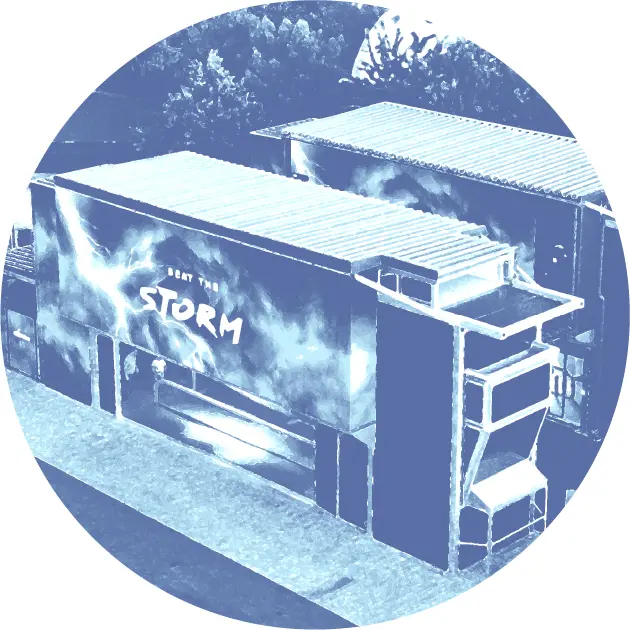
Simulating a tropical cyclone sounds like it should cost a fortune to run. It doesn’t. Two engineering choices — air recirculation and variable-speed drives — bring Beat the Storm’s electricity use down to roughly €0.16 per guest.
1. Recirculate the air
At the core of the attraction is a patented horizontal recirculation wind tunnel. Instead of pushing air through once and dumping it, the design loops the airflow back through the system. That recovered energy is the difference between a wind machine and an efficient one.
2. Run the fans only as fast as needed
The fan system is driven by 12 variable-speed Danfoss VLT HVAC drives. Rather than running direct-on-line at full draw, the drives match fan speed precisely to the wind profile each guest needs — gentle at the entrance, hurricane-force at the epicentre.
The result, measured on the installed units: about an 80% reduction in electricity consumption versus direct-on-line operation — and the same 80% cut in CO₂ emissions. As the Danfoss team put it: “More fun per kWh.”
Why operators care
Energy is the variable cost that scales with every rider. Keeping it low protects margin at exactly the moment throughput is highest. Combined with the rest of the operating model, the running cost stays predictable:
- One operator per two units — labour stays flat as you scale.
- Maintenance once per year — heavy-duty components, minimal downtime.
- 80% of materials recyclable — a sustainability story you can market.
- 61 dBA at 120 km/h — quiet enough for indoor venues.
Key takeaway
Low, predictable energy cost is not a footnote — it is a core part of the 2–3 year payback. The efficiency that makes the attraction sustainable is the same efficiency that makes it profitable.